

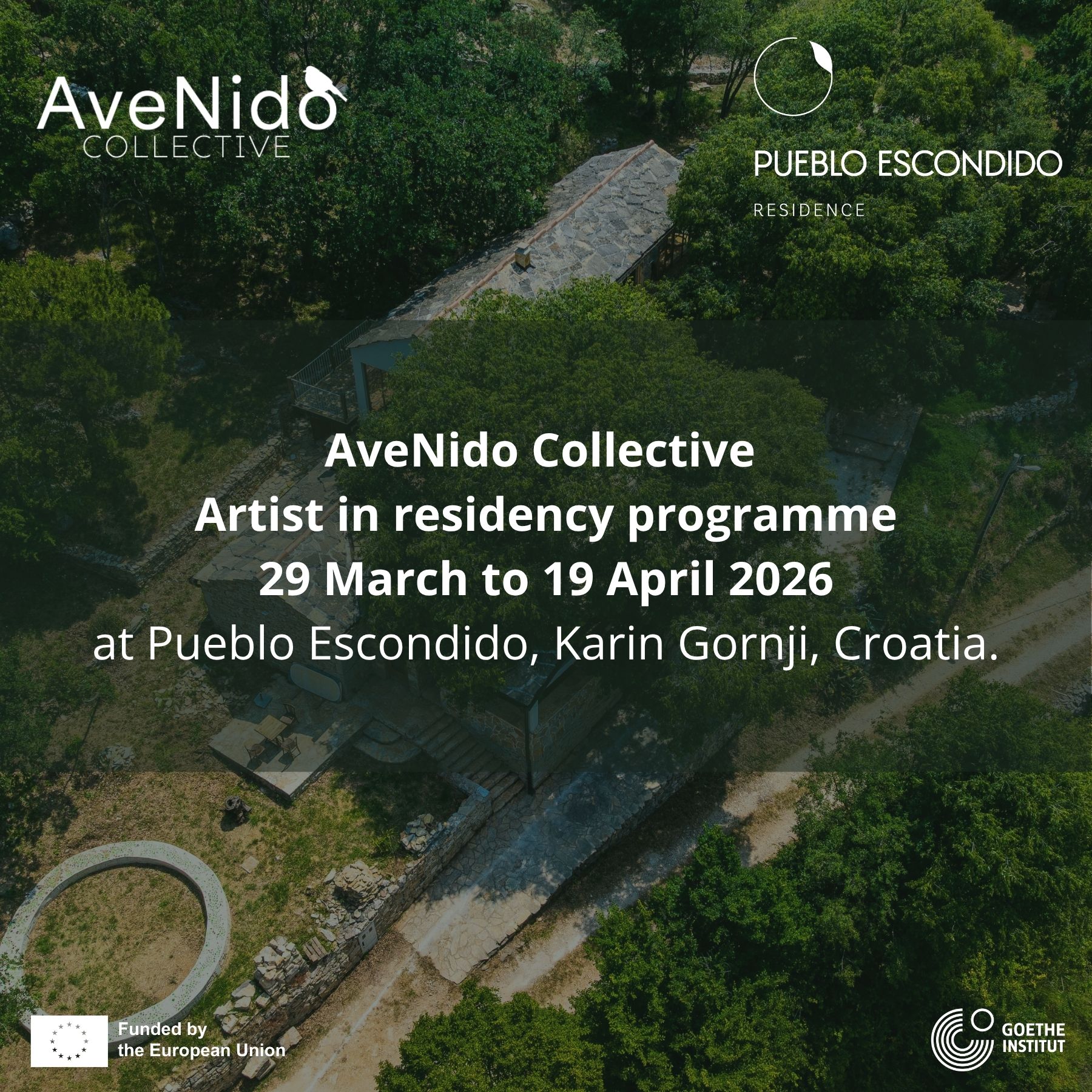
Artist residency announcement and public invitation
About the residency
From 29 March to 19 April 2026, an international multidisciplinary team is in residence at Pueblo Escondido in Karin Gornji, Croatia, developing AveNido Collective, an educational outdoor serious game designed to help organisations address key internal challenges through embodied play, ecological thinking, collaboration, and structured reflection. The residency is realised in collaboration with Udruga Lončari and will culminate in a public play test on 11 April 2026.
About the game
AveNido Collective is conceived as a modular outdoor serious game system for companies and SMEs, NGOs and social enterprises, institutions, universities, and educational organisations seeking stronger internal communication, collaboration, motivation, and talent discovery. Grounded in the ecological landscape of Zadar County, the system uses natural environments, role asymmetry, field observation, mapping, and reusable materials to make organisational dynamics visible through play. The public test will focus on the Living Ecosystem module, in which teams design and build a sustainable micro-ecosystem through spatial reasoning, ecological constraints, and collective decision-making.
Play test day
The play test day on 11 April is structured as both a public event and a research phase for the game system. After registration and a short online pre-assessment, participants will be placed into small mixed teams of four rather than larger open groups. Each team is ideally composed of one Explorer, one Cartographer, one Scientist, and one Builder, with role assignment used to create cognitive diversity and reveal different patterns of communication and cooperation. Teams begin at the Control Center, receive their role cards and scenario briefing, then move through two connected phases: Phase 1 is planning and map-building, in which field observations are translated into a shared decision surface; Phase 2 is execution in the terrain, where the agreed ecosystem elements are physically placed or built. During play, selected disruption cards from the AveNido Avian Deck may alter movement, communication, or information flow, making the session a live test of adaptability, coordination, and decision quality. The day concludes with participant feedback, stakeholder reflection, a closing circle, a press moment, and a shared social lunch at Pueblo Escondido.
Indicative public schedule
| Time | Flow |
| 10:00-10:30 | Arrival, registration and short pre-assessment |
| 10:30-11:00 | Team briefing, safety framing, role assignment and team formation |
| 11:00-14:40 | Living Ecosystem module: planning phase, execution phase and shared lunch break |
| 14:50-17:00 | Feedback collection, stakeholder reflection, closing circle, press moment and debrief |
About Pueblo Escondido
Pueblo Escondido is a residency and cultural space in Karin Gornji, near Zadar, developed within a restored traditional rural property and garden using natural materials and site-sensitive design. Located in protected natural surroundings and equipped for workshops, prototyping, and practical making, it supports artistic research, collective living, public presentations, and hands-on work with materials such as wood and stone. Its setting makes it a natural context for a game system that connects ecological awareness, craftsmanship, and group learning.

About Udruga Lončari
Udruga za poticanje zaštite okoliša, očuvanje prirode te promicanje održivog razvoja i turizma “Lončari” is a civil society organisation based in Karin Gornji / Obrovac, Zadar County. The association works across environmental protection, biodiversity, sustainable rural development, educational activities, and participatory cultural initiatives. Through community-based projects and ecological actions, Lončari links environmental stewardship, local regeneration, and social inclusion in rural contexts.
Residency team
The residency participants bring together complementary practices in game design, psychology, visual communication, facilitation, and production: Guido Racinelli (Milan) leads methodology and interaction design; Jorge Luis Socorro Batista (Las Palmas de Gran Canaria) contributes as lead game designer; Madalina Maria Vochin (Castellon de la Plana) works on psychology, group dynamics, and feedback processes; Silvia Sofia Barrios Hernandez (Florence) develops the visual and graphic language of the project; Mirjana Ostojic (Milan) works on physical game assets and spatial flow; Jasen Lakic (Karin Donji) contributes as production director and game designer; Marko Simic (Karin Gornji) joins as host and interaction designer; and Marin Mutic (Karin Gornji) supports the residency as production assistant.
About birds inspire us
In the Tuvina–Karin mudflat zone, part of the wider protected natural landscape around Karin, wetland birds are not only a symbol of local biodiversity but also a key inspiration for AveNido. The game draws on species that can be recognized in the design documents — such as the Black-winged Stilt, Great Cormorant, Grey Heron, Eurasian Bittern, Great Reed Warbler, and Western Marsh Harrier — turning their real behaviours into play logic about balance, observation, timing, communication, and adaptation. In this way, the birds of the Karin wetlands are present in the project not as decoration, but as living ecological references that connect the game to the specific character of this landscape.
Jasen Lakic production director about his experience in the project:
“For me, this residency has a deeply personal meaning. After years of entrepreneurial work and professional experience developed in and around Brussels, it is especially meaningful to bring that energy, knowledge, and creativity back to the place where I was born and where I live today. Working on AveNido Collective in Karin Gornji allows me to turn ideas into something tangible in a landscape and a community that are part of who I am. I am genuinely happy that this project is growing here, at home, and that we can create something playful, useful, and locally rooted while opening it to wider international audiences.”
Notes to editors
Supported by Culture Moves Europe, a project funded by the European Union and implemented by the Goethe-Institut.

Disclaimer
This work was produced with the financial assistance of the European Union. The views expressed herein can in no way be taken to reflect the official opinion of the European Union.